Is Diving in Alor Safe? A Guide for Cautious Adventurers
- Safety is contingent on understanding the predictable hydrodynamics of the Pantar Strait.
- Expert local guides with generational knowledge are non-negotiable for navigating these waters.
- Adherence to conservative dive profiles and the use of high-quality, well-maintained equipment are paramount.
An Unvarnished Look at Alor’s Underwater Realm
The air hangs heavy and warm, thick with the scent of cloves and salt spray from the Savu Sea. Below the polished deck of the phinisi, the water shifts from turquoise to a profound, mysterious indigo. This is the Alor Archipelago, a string of volcanic islands cast adrift between the Flores and Banda Seas. It’s a place that exists on the periphery of the popular imagination, known to a select cadre of divers for its mind-altering biodiversity and, yes, its formidable currents. The question lingers in the minds of even the most seasoned underwater explorers considering a visit: Is a journey into this wild heart of the Coral Triangle truly safe? As an editor who has spent two decades evaluating the world’s most exclusive and remote destinations, I can tell you the answer is not a simple yes or no. It’s a matter of preparation, knowledge, and, most critically, the provenance of your guide.
Understanding Alor’s Legendary Currents: The Pantar Strait’s Hydrodynamics
To discuss safety in Alor is to first discuss its currents. They are the architects of this entire ecosystem. The archipelago sits directly in the path of the Indonesian Throughflow, a massive ocean current that funnels an estimated 15 million cubic meters of water per second from the Pacific to the Indian Ocean. The Pantar Strait, the deep channel separating the islands of Alor and Pantar, acts as a natural chokepoint, amplifying these flows to create some of the most nutrient-rich, and at times challenging, diving conditions on Earth. This is not the gentle, bathwater drift of a Caribbean reef. These are powerful, oceanic forces that command respect.
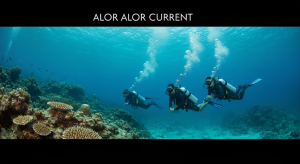
However, what is powerful is not necessarily dangerous; it is simply misunderstood. “The currents are the engine of Alor’s biodiversity. They are not to be feared, but respected and understood,” explained Dr. Ardi Santoso, a marine biologist I spoke with in Jakarta who has spent years studying the region. The key is predictability. These flows are governed by massive tidal exchanges, creating periods of relative calm, or slack tide, that offer perfect windows for exploration. A truly professional operation doesn’t fight the currents; they dance with them. Dives are meticulously planned around lunar cycles and tide charts, often with schedules adjusted by as little as 30 minutes to hit the optimal conditions. This deep understanding of oceanography is precisely what separates professional Alor diving expeditions from standard dive trips. The result is exhilarating drift dives where the current does the work, carrying you along vibrant coral walls teeming with life brought in on the aquatic superhighway.
The Non-Negotiable Role of Expert Local Guides
If the currents are Alor’s engine, the local guides are its navigators. In a destination this complex, the single most critical safety component is the human one. Your guide’s experience is worth more than any piece of equipment. We are not talking about a 22-year-old on a gap year who just received their Divemaster certification. The best guides in Alor possess a form of aquatic intelligence that cannot be taught in a classroom. They have spent thousands of hours in these specific waters, often hailing from families who have fished the Pantar Strait for generations. They can read the subtle texture on the water’s surface to predict what’s happening 20 meters below. They know which side of a seamount will have a protective eddy during a running tide and where the hammerheads are likely to school in the cool upwellings of September.
I recall a conversation with a lead guide named Budi on a recent trip, who had over 5,000 dives in the Alor Regency alone. He explained, “I don’t just look at the tide chart. I look at the wind, the clouds over Pantar, and the way the small baitfish are schooling. It all tells a story.” This is the level of granular, localized expertise that ensures safety. It’s the difference between being dropped into a potential washing machine and being guided into a gentle, flowing river of life. When vetting an operator, ask about the lead guide’s specific Alor experience. A low guide-to-diver ratio, typically no more than 1-to-4 on advanced sites, is another crucial indicator of a commitment to personal attention and safety.
Decompression Sickness and Medical Infrastructure: A Realistic Assessment
Let’s be direct: Alor is remote. That is a core part of its allure, but it is also a critical safety consideration. The city of Kalabahi has a local hospital, but for a serious dive-related injury like Decompression Sickness (DCS), specialized treatment is required. The nearest recompression chamber is not on the island; it is a significant distance away in a location like Bali or Manado, requiring a medical evacuation flight that can take hours and cost upwards of $25,000. This reality dictates an unwavering commitment to prevention. There is no room for error or for pushing the limits of no-decompression times.
This is why the operational standards of your chosen expedition are so vital. A premier operator insists on conservative dive profiles, with every diver using a personal dive computer. Safety stops at 5 meters for 3 minutes are not optional suggestions; they are mandatory protocols. Onboard, the presence of a comprehensive medical kit, DAN-standard emergency oxygen systems capable of delivering high flow rates, and a crew trained in emergency first response is the baseline. Before booking, you should confirm that your operator has a clear, documented, and tested Emergency Action Plan. Furthermore, comprehensive dive insurance that specifically covers medical evacuation is not just recommended; it is an absolute requirement for any responsible traveler venturing to this part of the world. For broader travel health information, indonesia.travel provides a solid starting point for government-level advice.
Marine Life Encounters: From Pygmy Seahorses to Pelagic Predators
The sheer density of marine life in Alor is staggering. The region is a jewel within the Coral Triangle, an area that holds over 76% of the world’s known coral species and more than 3,000 species of fish. From a safety perspective, the concern for many is not the tiny critters but the larger pelagic animals. Sightings of thresher sharks, schooling hammerheads, and even the occasional mola mola are a major draw. It’s important to understand that these animals pose virtually no threat to divers. In almost all cases, these are shy, deep-water creatures, and a sighting from 30 meters away is a rare privilege. The real, albeit minimal, risk from marine life comes from defensive, camouflaged creatures on the reef itself, like the stonefish or scorpionfish.
The cardinal rule of safe marine interaction is simple: look, but do not touch. This is a matter of both personal safety and ecological preservation. A skilled guide will be adept at pointing out these hidden animals from a safe distance. Excellent buoyancy control is your best defense. By staying a meter or more away from the reef, you protect both yourself and the fragile coral ecosystem that has thrived for millennia. The pre-dive briefings provided by a first-rate operation will always include specific information on the marine life you are likely to encounter and the proper, respectful way to observe it. This focus on education is a hallmark of the finest Alor diving experiences.
Choosing Your Operator: The Single Most Important Safety Decision
Ultimately, the answer to “Is diving in Alor safe?” comes down to a single, critical choice: your operator. A well-managed, safety-conscious expedition transforms Alor from a potentially hazardous environment into one of the world’s most rewarding dive destinations. A budget-conscious or inexperienced outfit can do the opposite. For the discerning traveler, the vetting process should be rigorous. Look beyond glossy brochures and focus on the fundamentals. What is the vessel’s safety rating and when was its last dry-dock inspection? Is the navigation and communication equipment modern and redundant? What is the maintenance schedule for the dive compressors and rental gear? Poorly maintained equipment or, worse, impure air fills, are silent but serious threats.
Inquire about the crew. How many years has the Cruise Director been operating specifically in Alor? What are the qualifications of the dive team beyond basic certifications? A premier liveaboard will have a crew that has worked together for multiple seasons, operating as a seamless unit. The level of detail in the pre-dive briefing on a vessel like those used for premier Alor diving expeditions is a world away from a standard day-boat operation. They will discuss entry and exit procedures, current direction and strength, maximum depth and time, and contingency plans before anyone even touches the water. This meticulous approach is the bedrock of a safe and memorable adventure.
Quick FAQ: Your Alor Diving Safety Questions Answered
Q: What level of certification is required for Alor?
A: Due to the potential for deep dives and strong currents, an Advanced Open Water certification with a minimum of 50 logged dives is the standard recommendation. Certifications in Deep Diving and Drift Diving are highly beneficial, and some operators may require them for specific sites. The key is comfort and recent experience in challenging conditions.
Q: Is travel and dive insurance absolutely necessary?
A: Yes, it is non-negotiable. Standard travel insurance is often insufficient. You must have a specific policy that covers scuba diving to your certified depth and includes a significant provision for emergency medical evacuation, with a recommended minimum coverage of US$500,000.
Q: What about seismic activity in the region?
A: Indonesia is located on the Pacific Ring of Fire and seismic activity is a fact of life. Reputable liveaboard operators are well-prepared. Their vessels are built to SOLAS (Safety of Life at Sea) standards to handle open-ocean conditions, and they constantly monitor official seismic and tsunami warnings, with established protocols to move to safe, deep water if necessary.
Q: Are there any specific health concerns for the Alor area?
A: Beyond the usual travel health precautions for Southeast Asia, it’s wise to consult a travel medicine specialist 6-8 weeks before your departure. They can advise on recommended vaccinations and malaria prophylaxis, as the risk, while low on a liveaboard, is present in the region.
Alor is not a destination for the novice diver, nor is it for the traveler who prioritizes convenience over substance. It is a challenging, wild, and profoundly beautiful place that rewards preparation and respects expertise. The currents that carve its underwater canyons also carry the nutrients that fuel an explosion of life found almost nowhere else. Safety here is not a passive guarantee; it is an active process, a partnership between a prepared diver and an elite, knowledgeable operator. For those who demand this level of assurance, exploring the tailored voyages offered by Alor Diving Expeditions is the logical next step in planning an memorable journey into Indonesia’s aquatic heart.