Pantar land-based pelagic week
Around 18 to 20 dives on wide-angle walls and big-animal drifts, from a 16-diver resort reaching 40-plus sites.
Silo 3 · Encounters
Wide-angle big-animal action across the Pantar Strait: schooling fish, mola mola, dolphins, pilot whales, occasional orcas and thresher sharks. Everything framed as possible, never predictable.
Wide-angle country
The Pantar Strait is wide-angle country. Strong, nutrient-heavy current pulls plankton, baitfish and everything that eats them through a narrow channel, so a single drift can stack schooling fish, oceanic sunfish and cetaceans into one frame.
Everything is framed as possible, not predictable. Marine mammals are wild and current-driven. No operator can promise a sighting, and we will never date-stamp a guaranteed blue whale. This is the broad-spectrum page: if you want one shot at a single species, ask about the dedicated blue-whale and hammerhead trips.
Most pelagic dives sit at 15 to 25 metres, with a rapid descent and a regroup around 5 metres once the current grabs you.
Honest odds
Six things the strait turns up, each with the honest frame attached.
| Species / spectacle | Where | Best window | Honest frame |
|---|---|---|---|
| Mola mola (oceanic sunfish) | Pantar Strait deep sites | September | Seasonal, thermocline-dependent |
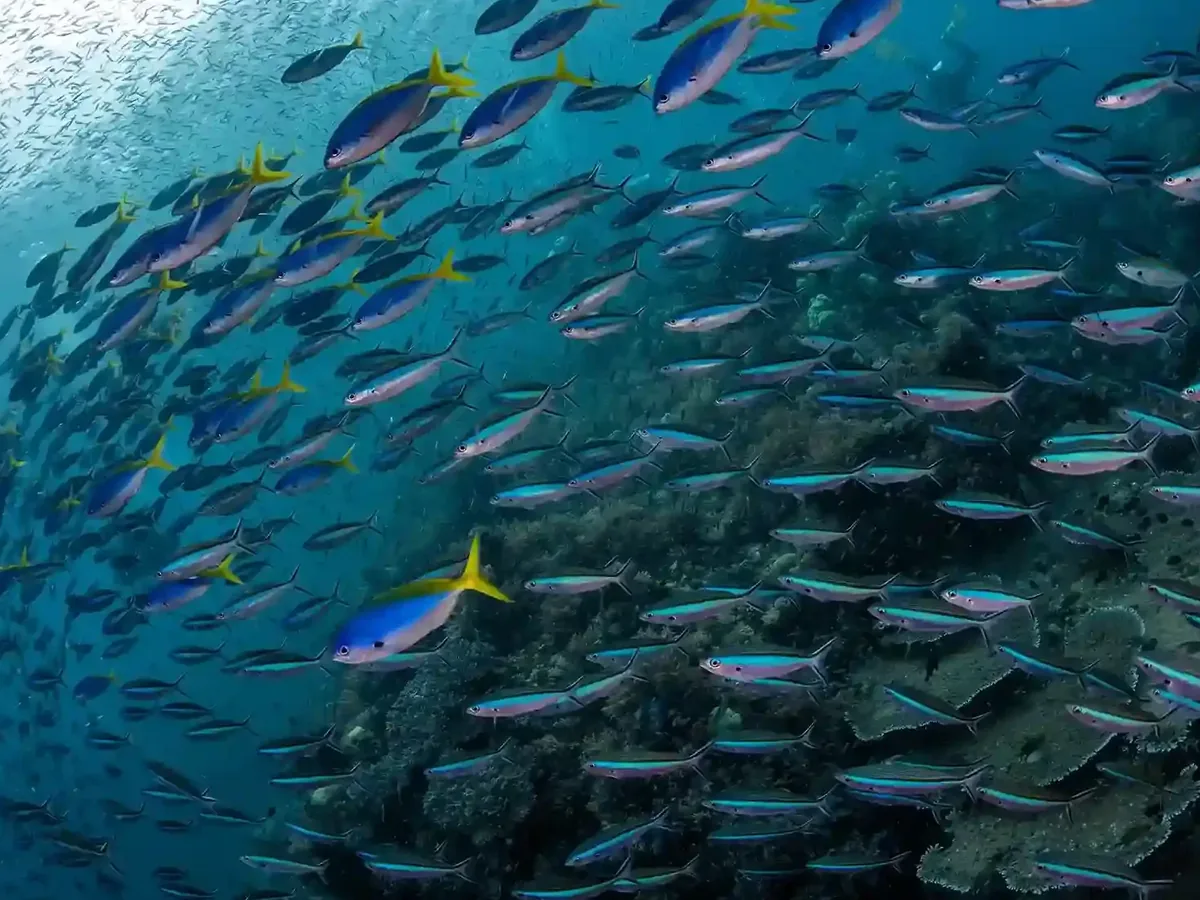
| Schooling trevally, barracuda, fusiliers | Wide-angle walls | Apr–Nov | Reliable in strong current |
| Dolphins & pilot whales | Open channel crossings | Apr–Nov | Surface and in-water, chance-based |
| Occasional orcas | Deep channel | Apr–Nov | Rare, never guaranteed |
| Scalloped hammerheads / threshers | Deep current site (~32 m) | Possible, not predictable | Advanced fitness only |
| Blue whales | Alor–Pantar channel | No fixed dates | Passage only, never guaranteed |
The one documented scalloped-hammerhead site drops to roughly 32 metres in very strong current and demands genuine fitness.
The calendar
October and November bring the most prevalent currents — exactly what concentrates big animals. September is the standout month for mola mola.
| Window | Water temp | Visibility | Pelagic note |
|---|---|---|---|
| Apr & Oct–Nov | ~25°C | 25–30 m | Strongest currents; mola mola in September |
| May–Sep | 31–32°C surface | 15–40 m, bloom-dependent | Thermoclines can hit 20°C or lower |
| Nov–Mar (rainy) | Cooler, unsettled | Reduced | Rough surface; we generally steer trips out of this window |
Plankton is a trade-off: it clouds the water yet feeds the food chain that draws pelagics in. Bring an extra layer regardless of the calendar.
Four shapes
Land-based for flexible, repeatable drifts; liveaboard for wider ground in the September–October window.
Quoted per trip
No citable public price table exists for Alor dive packages, liveaboards or the marine park fee — only that a fee and permit are mandatory.
Quotes exclude the marine park fee and permit, mandatory DAN or equivalent dive-accident insurance, and flights into Alor via Kupang.
Five steps
We handle the permits, timing and logistics so you just dive.
Start here
We build the itinerary around what you most want to see and what your logbook can handle.
Non-negotiable
Every diver attends a compulsory MPA officer briefing, pays the marine park fee and holds a permit before entering the water. Fishing and spearfishing are off-limits to visitors.
Protected species here include coral reefs, turtles, marine mammals, thresher sharks, mangroves, seagrasses and pelagic fish.
Straight answers
No. Blue whales pass through the Alor–Pantar channel on no fixed schedule, and hammerheads appear at one deep, very-strong-current site around 32 metres. We frame both as possible, never predictable, and refuse to invent peak dates. A pelagic-combo trip simply widens your odds across mola mola, dolphins, pilot whales and schooling fish too.
September is the best month to spot mola mola in the Pantar Strait, when thermoclines lift the oceanic sunfish into diveable depth. It also overlaps the strong late-year currents that concentrate pelagics. Book early, since WWF carrying-capacity caps limit diver numbers per site during this popular window and slots fill fast.
The minimum for fun diving is PADI Open Water, but Alor operators strongly recommend 50 to 100 logged dives. Pantar Strait currents demand a rapid descent, quick equalising and a regroup near 5 metres. The deep hammerhead site reaches roughly 32 metres in very strong current and needs solid fitness, so honest self-assessment matters more than the card alone.
Yes. DAN or equivalent dive-accident insurance is mandatory because the nearest hyperbaric chamber is in Bali, and evacuation plus chamber treatment fall outside standard medical insurance. We confirm your cover before departure. Alor's remoteness is part of its appeal, but it also means self-sufficiency on safety is non-negotiable.
Both work. A Pantar land-based resort hosts 16 divers and reaches 40-plus sites within 30 to 45 minutes, ideal for flexible, repeatable pelagic drifts. An Alor Sea liveaboard, boarding at Kalabahi Bay in the September–October window, covers wider ground including sites like Pasir Merah. We match the format to your dates, budget and target species.

Silo 3 · Encounters
Next step
Send your dates and dive experience and we build a pelagic itinerary around your target species and skill level, through a vetted, licensed Alor operator.