
Alor Macro and Wide-Angle Photo Tips: Settings, Subjects and Logistics
Alor rewards two cameras’ worth of thinking. Shoot macro in Kalabahi Bay’s black-sand muck — Pegasus sea moths, mimic octopus, seahorses, nudibranchs and frogfish sit still for portraits year-round — and switch to wide-angle in the Pantar Strait, where schooling fish, mola mola and dolphins demand a dome port and fast reflexes.
What macro subjects actually sit still for you in Alor?
Kalabahi Bay is the headline for critter shooters. This volcanic black-sand bay on Alor’s coast is a muck-diving hotspot where the loose sediment hides an outsized cast of small, slow, photogenic subjects: Pegasus sea moths crawling the slope, mimic octopus flaring across open sand, ornate seahorses, dense nudibranch traffic, and frogfish parked like lumps of sponge.
Because these animals don’t roam far, the muck stays productive year-round — unusual in Indonesian diving, where many highlights come and go with the season. Alor and Pantar sit in the eastern Lesser Sunda Islands of East Nusa Tenggara, deep inside the Coral Triangle, so the species density in front of your lens is genuinely high. You rarely waste a dive hunting for a subject; you waste it deciding which of three frogfish to frame first.
What camera settings work for Alor’s black sand?
Black sand is a gift. It absorbs light and hands you clean, near-black backgrounds without a snoot. The trade-off is autofocus hunting on low-contrast critters, so a strong focus light earns its place on the rig. Treat the numbers below as starting points and meter every frame.
| Macro setting | Starting point | Why it works |
|---|---|---|
| Shooting mode | Manual | Full control of exposure and strobe balance |
| Aperture | f/16–f/22 | Maximum depth of field, eye-to-tail sharpness |
| Shutter | 1/200–1/250 s | Kills ambient, freezes critter twitch |
| ISO | 100–200 | Clean files; black sand renders truly black |
| Strobes | Dual, pulled in close | Even light; add a snoot for isolation |
| Focus light | Dimmable, red option | Locks AF without spooking the subject |
A good macro guide points, holds position in current, and never touches the animal — which is why our Alor macro diving expedition packages are built around MPA-certified guides who already know where the mimic octopus dens and resident seahorses sit. Pointing beats searching when a 60-minute bottom-time limit is ticking.
When does wide-angle beat macro in the Pantar Strait?
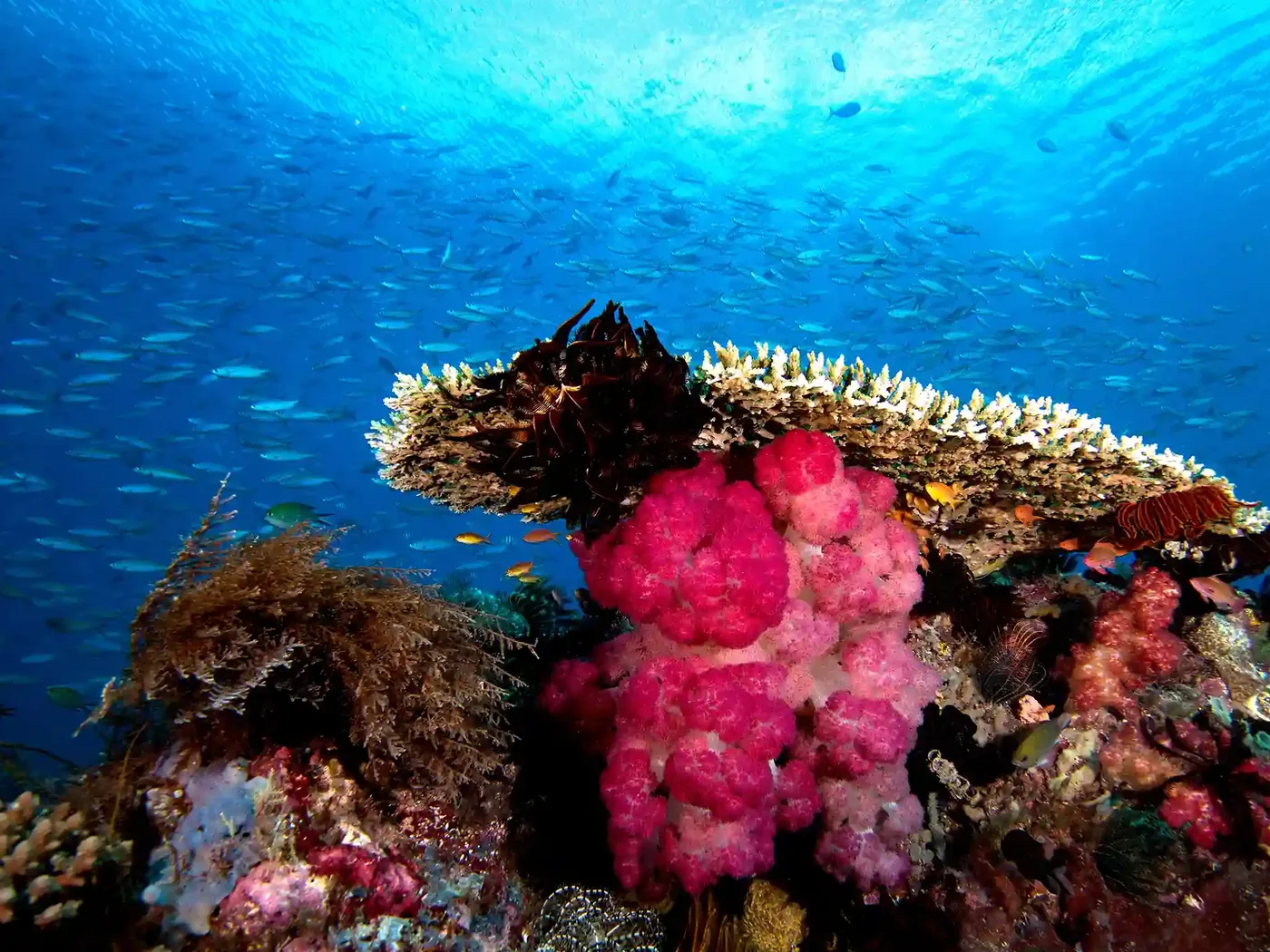
Switch lenses when you leave the bay. The Pantar Strait favours wide-angle: schooling fish stack into walls, mola mola cruise through, and dolphins, pilot whales and the occasional orca pass in the blue. September is the strongest month for mola mola sightings. Blue whales and scalloped hammerheads are possible here, not predictable — plan for the reef in front of you and treat a big pelagic as a bonus, never a promise.
Conditions steer the wide-angle window. Diving is best from April to November, and visibility runs a normal 25–30 metres, climbing to around 40 metres in the dry season from June to October. May-to-September plankton blooms can drop it to 15 metres or less — good for plankton feeders, harder for big blue scenes. Water sits near 25°C in March–April and October–November and warms to 31–32°C from May to September, though thermoclines can punch some sites down to 20°C, so carry the exposure protection that keeps your hands steady on the controls.
| Wide-angle setting | Starting point | Why it works |
|---|---|---|
| Aperture | f/8–f/11 | Balances dome-corner sharpness with ambient blue |
| Shutter | 1/125–1/200 s | Holds water colour, freezes schooling motion |
| ISO | 200–400 | Lifts shadow detail when visibility drops to 15 m |
| Port | Dome, fisheye or wide zoom | Close-focus wide angle, big reef scenes |
| Strobes | Twin, pulled wide and back | Lights the foreground, avoids backscatter |
| White balance | Reset manually at depth | Corrects the deep-blue cast |
How do current and MPA rules shape your shooting?
Alor’s waters are a marine protected area, and the rules are not optional. Every diver must attend a mandatory briefing by MPA officers, pay a marine park fee, and hold a permit before entering the water; guides carry special MPA certification on top of standard agency cards, and diver numbers per site are capped by WWF-determined carrying capacity. That structure is good for photographers — fewer divers means fewer fin-kicks stirring your black-sand background.
The current is the real test. The Pantar Strait throws strong surface currents that demand a rapid descent, quick equalising, and a regroup around 5 metres. You cannot shoot on the way down. Clip the camera to your BCD, get negative on entry, drop fast, and only lift the rig once the group settles onto the reef, typically between 15 and 25 metres. One documented scalloped-hammerhead site drops to around 32 metres in very strong current and demands real fitness, not a distracted photographer. Currents are most prevalent in October and November, so brace and let subjects come to you rather than chasing them across the reef.
What about rinse, charge and topside logistics?
Photo trips live or die on the surface interval. Land-based options help: a longstanding Pantar dive resort hosts just 16 divers in traditional-style bungalows, runs small, quiet, low-emission boats, draws on its own underground water reserve, and reaches 40-plus dive sites within 30 to 45 minutes — short runs that keep housings out of the sun. Liveaboards such as a Seven Seas Alor Sea itinerary work the strait in the September–October window, boarding at Kalabahi Bay and diving sites like Pasir Merah, a volcanic red-sand slope with gas vents north of Pura Island.
Wherever you sleep, keep the workflow tight:
- Rinse camera and strobes in a dedicated freshwater tank immediately — never the wetsuit rinse tank.
- Charge every battery overnight; strong currents mean more strobe pops per dive and faster drain.
- Open housings only in dry, air-conditioned space to stop condensation fogging your port.
- Carry spare O-rings, silicone grease and a blower; salt and humidity are relentless.
- Offload and back up cards each night before the batteries recharge.
Do this and Alor gives you two portfolios from one trip: intimate black-sand macro and sweeping current-swept wide-angle. All conditions above are as of 2026 and subject to change with weather and season.
Frequently Asked Questions
Should I bring both macro and wide-angle setups to Alor?
Bring both, but you can’t swap lenses underwater, so choose per dive. Rig macro for Kalabahi Bay’s black-sand muck and wide-angle for the Pantar Strait’s schooling scenes and passing mola mola. Tell your guide your lens choice during the mandatory MPA briefing so they lead you to the right subjects and depths.
Can I photograph in Alor’s strong currents without ruining my shots?
Not during the descent. The Pantar Strait’s strong surface currents force a rapid drop and a regroup around 5 metres, so clip your camera off and equalise fast first. Once the group settles on the reef between 15 and 25 metres, then shoot. Currents peak in October and November, so brace, don’t chase.
Does black sand really give better macro photos than reef?
For isolation, yes. Kalabahi Bay’s volcanic black sand absorbs light, so a well-aimed strobe gives you a clean, near-black background straight out of the housing — no snoot required. The catch is autofocus: low-contrast critters on dark sand make lenses hunt, so a dimmable focus light is essential to lock focus without spooking the animal.
More from the journal
Keep reading
Alor vs Komodo Liveaboard Costs: A 2026 Diver’s Breakdown
Alor liveaboards usually cost more per dive than Komodo ones for structural reasons: long crossings, heavy fuel burn and thin…
Alor–Pantar Strait Hyperbaric and Evacuation Logistics: A 2027 Safety Outlook
The nearest recompression chamber to the Alor–Pantar Strait sits in Bali, hundreds of kilometres and a multi-leg journey west, so…
Alor to Komodo Frontier Liveaboard Expeditions: A 2027 Route Outlook
An Alor-to-Komodo frontier liveaboard expedition strings together two of Indonesia's wildest dive regions in one crossing — current-swept Pantar Strait…
Community-Based Marine Conservation Projects in Alor: A 2027 Outlook
Community-based marine conservation in Alor centers on the Alor marine protected area (MPA) around Kalabahi Bay and the Pantar Strait,…
Alor and Forgotten Islands Combination Itineraries: A 2027 Crossing Guide for Photographers
A combination itinerary pairs Alor and Pantar's current-swept walls with the remote Forgotten Islands arc toward Banda — usually a…
Kupang Gateway Guide for Alor Divers: 2027 Group Logistics
Kupang — the East Nusa Tenggara provincial capital on Timor — is the practical mainland gateway for dive groups bound…