
Comparing Alor and Komodo Diving: Currents, Crowds and Marine Life
Alor and Komodo both deliver world-class current diving in East Nusa Tenggara, but they are not interchangeable. Komodo is the established, manta-rich circuit reached easily from Labuan Bajo. Alor is the remoter, quieter frontier of gorgonian walls, volcanic muck and seasonal pelagics — for experienced divers who accept stronger, less-charted currents and fewer boats.
Both destinations sit in the eastern Lesser Sunda Islands, inside the Coral Triangle, one of the most biodiverse marine regions on the planet. They share warm water, strong tides and dramatic drop-offs. What they don’t share is maturity: Komodo has been on the global dive map for decades, while Alor is only now drawing serious attention. That single difference shapes almost everything below.
How do Alor and Komodo diving compare at a glance?
Here is the short version before we get into detail. Figures for Alor are drawn from local operators and marine-park rules as of 2026 and are subject to change; Komodo entries reflect widely dived, commonly reported conditions.
| Factor | Alor / Pantar Strait | Komodo National Park |
|---|---|---|
| Access | Fly to Kalabahi via Kupang; fewer boats | Direct flights to Labuan Bajo; many day boats and liveaboards |
| Crowds | Very quiet; diver numbers capped per site | Busy, especially July–September and at manta sites |
| Signature sightings | Gorgonian walls, black-sand muck, mola mola, seasonal blue whales and hammerheads | Reef mantas, grey reef sharks, turtles, schooling fish |
| Currents | Strong, less charted; rapid descents required | Strong but well mapped |
| Experience level | Experienced divers; 50–100 logged dives recommended | Sites for most levels, plus advanced seamounts |
| Best months | April–November, currents strongest October–November | Divable most of the year; drier April–November |
Plenty of experienced divers refuse to pick one and instead run both on a single Nusa Tenggara trip. If that is your plan, our guide to Alor Komodo combination dive expeditions walks through the sequencing, travel logistics and how the two legs fit together without wasting days.
Which has stronger, trickier currents?
Both are tidal, current-driven destinations, so neither is a place for lazy drift diving. The gap is in predictability.
Komodo’s currents are famous but well charted. Guides know when the tides rip at sites like Batu Bolong and Castle Rock, and dive plans are built around slack windows. You still need good buoyancy and reef hooks at the exposed seamounts, but the timing is understood.
Alor’s Pantar Strait is more raw. Strong surface currents often demand a rapid descent, quick equalising and regrouping around 5 metres before the dive settles. Typical dives run 15–25 metres, and one documented scalloped-hammerhead site drops to roughly 32 metres in very strong current, which asks for genuine fitness. Currents are most prevalent in October and November, exactly when the pelagic action peaks. This is why Alor operators recommend 50–100 logged dives for comfort, with a minimum of PADI Open Water for fun diving, no solo diving, and bottom times capped at about 60 minutes or when a diver hits 50 bar.
Where do you actually escape the crowds?
This is the clearest split. Komodo National Park is a mainstream draw, and in the July–September high season popular sites can hold several boats at once, particularly the manta cleaning stations.
Alor is close to empty by comparison. Its waters are managed as a marine protected area where diver numbers per site are capped by WWF-determined carrying capacity, so you rarely share a wall with another group. A longstanding land-based resort on Pantar hosts just 16 divers in traditional-style bungalows and reaches more than 40 dive sites within 30–45 minutes by boat, using small, quiet, low-emission craft. That scale, plus the mandatory MPA briefing, marine-park fee and permit every visitor must obtain, keeps the pressure low. Fishing and spearfishing are off-limits to tourists, reserved for local fishermen.
What marine life separates the two?
Both are rich, but they specialise.
- Komodo strengths: reliable reef manta encounters, grey reef sharks, turtles, big schooling fish and colourful hard-coral reefs. It is a wide-angle and action destination first.
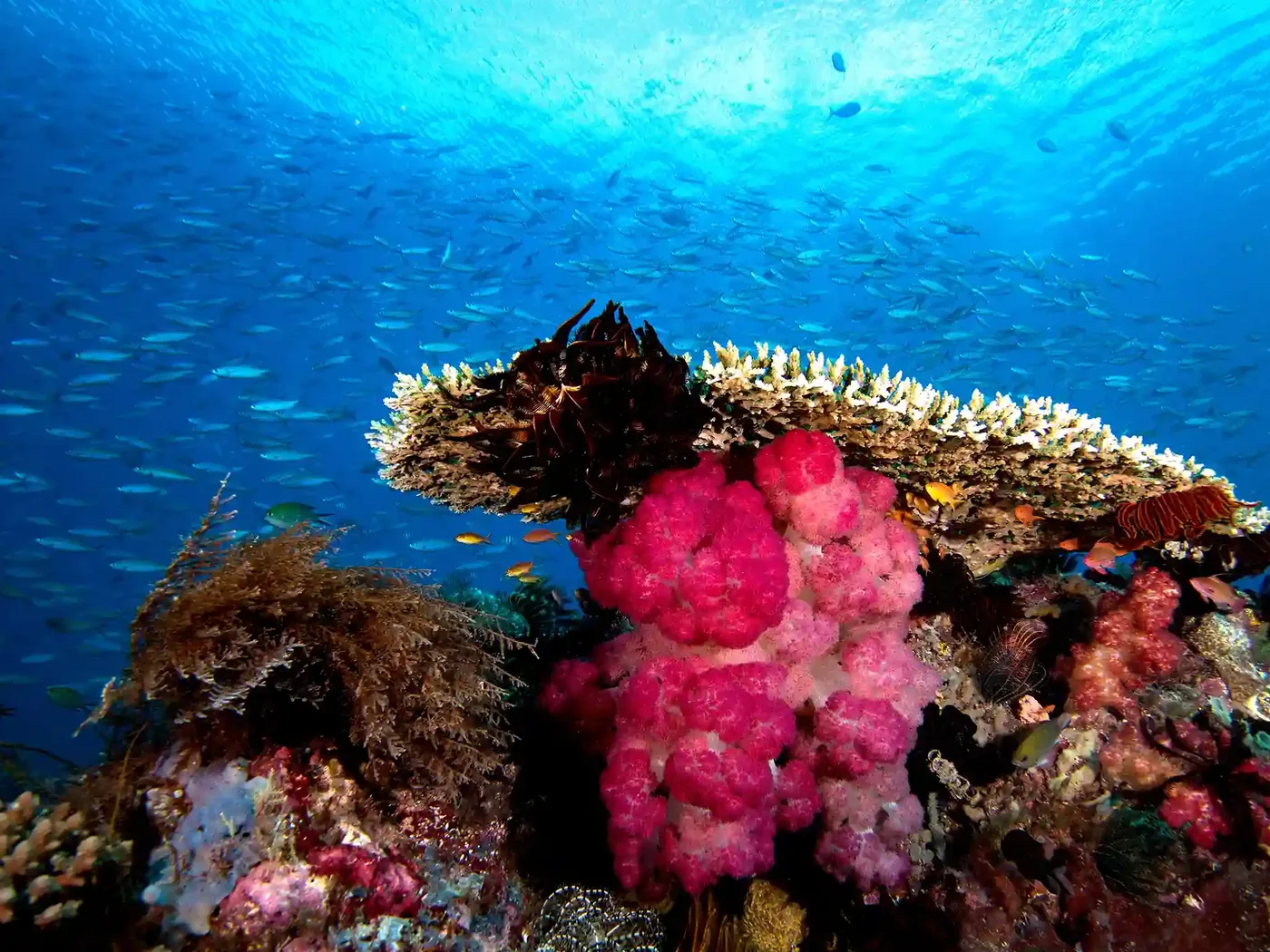
- Alor macro: Kalabahi Bay is a volcanic black-sand muck site loaded with Pegasus sea moths, mimic octopus, seahorses, nudibranchs and frogfish. Because these critters don’t travel far, the muck stays productive year-round — a rare guarantee in diving.
- Alor wide-angle and pelagics: Pantar Strait sites favour big scenes, with schooling fish, mola mola, dolphins, pilot whales and the occasional orca. September is the best month to spot mola mola. Blue whales and scalloped hammerheads are genuinely possible in season but never predictable, so treat any sighting as a bonus rather than a promise.
If you shoot macro seriously, Alor’s muck is hard to beat. If you want dependable big-animal reef dives, Komodo remains the safer bet.
When is each destination at its best?
Season planning matters more in Alor, where conditions swing harder.
| Window | Alor conditions | Notes |
|---|---|---|
| April–November | Best overall; visibility 25–30 m, up to ~40 m in the June–October dry season | Peak diving; October–November brings the strongest currents and pelagic chances |
| May–September | Water 31–32 °C, but plankton blooms can drop visibility to 15 m or less | Southeast monsoon; thermoclines can chill some sites to 20 °C or lower |
| November–March | Rainy season, unsettled surface, rain and reduced visibility | Water around 25 °C in March–April; muck sites still hold macro |
Komodo, by contrast, is divable through most of the year, with the southern sites turning cooler and greener as plankton feeds the mantas in the mid-year months, and the northern sites staying warmer and clearer.
Do you have to choose — and does Currentline sell Komodo?
No, you don’t have to choose, and here is the honest part. Currentline Alor is an independent concierge focused only on Alor. We arrange the Alor leg through licensed, established local operators — the likes of Dive Alor Dive, Nautika Dive Alor and Alami Alor — rather than owning boats or running trips ourselves. We do not operate, sell or quietly cross-book Komodo departures; if you pair the two, the Komodo portion is a separate arrangement, and we simply help the Alor half slot in cleanly.
One rule applies to both destinations: dive-accident insurance such as DAN cover is essential, because the nearest hyperbaric chamber is in Bali and evacuation and chamber costs are not covered by standard medical insurance. Neither region publishes fixed public price tables for packages or the marine-park fee, so any figures we quote are our own indicative estimates as of 2026 and subject to change, never presented as sourced facts.
Frequently Asked Questions
Is Alor more difficult to dive than Komodo?
Generally yes. Both have strong currents, but Alor’s Pantar Strait demands rapid descents, fast equalising and regrouping near 5 metres, with dives typically 15 to 25 metres and one hammerhead site around 32 metres. Local operators recommend 50 to 100 logged dives for comfort. Komodo offers beginner-friendly sites alongside advanced ones, so it suits a wider range.
Which has better macro diving, Alor or Komodo?
Alor’s Kalabahi Bay is a volcanic black-sand muck hotspot, holding Pegasus sea moths, mimic octopus, seahorses, nudibranchs and frogfish. Because these critters don’t travel far, the muck stays productive year-round. Komodo has capable macro sites too, but its fame rests on mantas and reef action, so dedicated muck photographers usually rate Alor higher.
Should I dive Komodo before Alor?
Many divers do, and it works well. Komodo mixes gentle and advanced sites that build current confidence, and it’s easier to reach through Labuan Bajo. Alor then rewards that experience with quieter, more demanding conditions and seasonal pelagics such as mola mola, best spotted around September. Neither destination replaces the other.
More from the journal
Keep reading
Alor vs Komodo Liveaboard Costs: A 2026 Diver’s Breakdown
Alor liveaboards usually cost more per dive than Komodo ones for structural reasons: long crossings, heavy fuel burn and thin…
Alor–Pantar Strait Hyperbaric and Evacuation Logistics: A 2027 Safety Outlook
The nearest recompression chamber to the Alor–Pantar Strait sits in Bali, hundreds of kilometres and a multi-leg journey west, so…
Alor to Komodo Frontier Liveaboard Expeditions: A 2027 Route Outlook
An Alor-to-Komodo frontier liveaboard expedition strings together two of Indonesia's wildest dive regions in one crossing — current-swept Pantar Strait…
Community-Based Marine Conservation Projects in Alor: A 2027 Outlook
Community-based marine conservation in Alor centers on the Alor marine protected area (MPA) around Kalabahi Bay and the Pantar Strait,…
Alor and Forgotten Islands Combination Itineraries: A 2027 Crossing Guide for Photographers
A combination itinerary pairs Alor and Pantar's current-swept walls with the remote Forgotten Islands arc toward Banda — usually a…
Kupang Gateway Guide for Alor Divers: 2027 Group Logistics
Kupang — the East Nusa Tenggara provincial capital on Timor — is the practical mainland gateway for dive groups bound…