
Alor Pantar Strait Diving Route Guide: Current, Zones and Seasons
Planning an Alor Pantar Strait diving route means reading current before scenery. Descend fast, dive with the flow, and match each site to conditions: gorgonian walls on moving water, Kalabahi Bay’s black sand when it slackens, and pelagic corners in October. The best window runs April to November.
The Pantar Strait separates Alor and Pantar in the eastern Lesser Sunda Islands of East Nusa Tenggara, deep inside the Coral Triangle where marine biodiversity ranks among the highest on Earth. Water moves hard here. A smart route is less about ticking off famous names and more about sequencing sites so the current works for you, not against you.
Why does current dictate every Pantar Strait dive route?
Surface currents in the strait can run strong enough that guides brief for a rapid, feet-first descent, quick equalising on the way down, and a regroup around 5 metres before the reef takes over. That single rule reshapes everything. You cannot amble at the surface waiting for stragglers; the group drops together or the site is lost downstream.
Alor sits inside a managed marine protected area. As of 2026, every diver, snorkeller and marine visitor must attend a mandatory briefing by MPA officers, pay a marine park fee, and hold a permit before entering the water. Dive guides need a special certification to lead inside the Alor MPA on top of standard agency tickets, and diver numbers per site are capped to a WWF-determined carrying capacity. Your route is therefore shaped by permits and quotas as much as by tide.
How do you plan up-current versus down-current entries?
The core tactic is simple to say and harder to time: enter up-current of the reef feature you want, ride the flow along it, and exit before the current sweeps you past the exit point. On walls, that means dropping at the up-current end of the gorgonian face and drifting its length while the fans feed in the moving water. On muck sites in Kalabahi Bay you want the opposite — slack or gentle water, so you can hover over black sand and hunt small subjects without being pushed.
Timing hangs on the tide table and the guide’s local read. Well-run operators such as those we curate for our Pantar Strait expedition packages sequence the day around slack windows for macro and running water for the walls, rather than diving sites in a fixed order.
Typical Pantar Strait dives run 15 to 25 metres. One documented scalloped-hammerhead site reaches around 32 metres with very strong current and demands real fitness — it is not a warm-up dive, and it belongs late in a trip when the group is dialled in.
Which Pantar Strait zones are walls, macro, or pelagic?
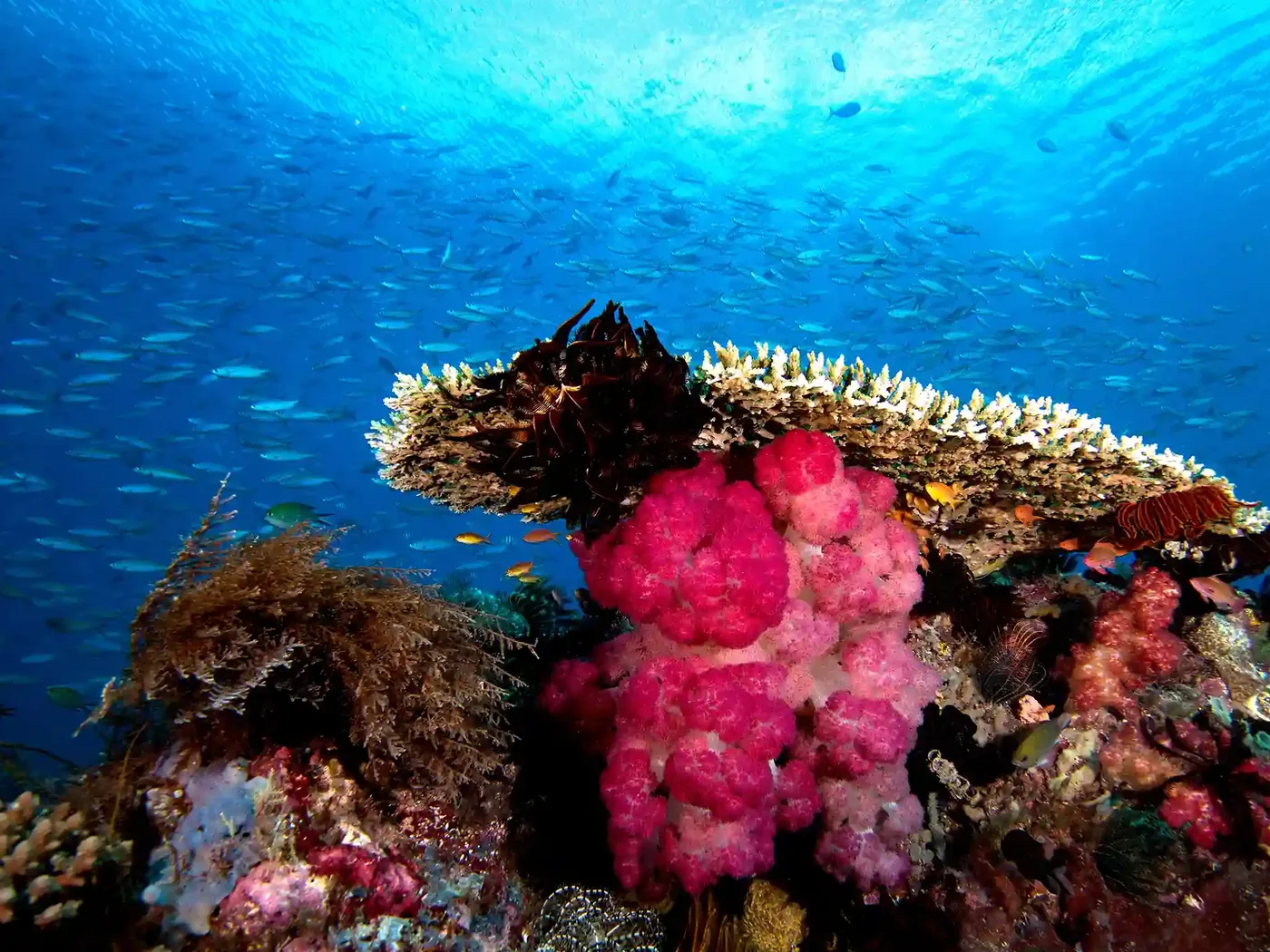
Three broad zones anchor route planning. Match each to the water state and to what you actually want to photograph.
| Zone | Signature sites | Best conditions | What you shoot |
|---|---|---|---|
| Gorgonian walls | Pantar Strait drop-offs | Moving water, dry-season clarity | Wide-angle: fans, schooling fish |
| Black-sand muck | Kalabahi Bay | Slack or gentle current | Macro: Pegasus sea moths, mimic octopus, seahorses, nudibranchs, frogfish |
| Pelagic corners | Strait channels near Pura Island | Running current, cooler thermocline | Mola mola, dolphins, pilot whales, occasional orcas |
Kalabahi Bay is a volcanic black-sand hotspot, and because its critters do not travel far, the muck diving holds up all year — a reliable fallback when the strait is too rough for walls. The wide-angle zones favour schooling fish and big animals; blue-whale and hammerhead encounters are possible here, never predictable, so plan for them as a bonus rather than a booking guarantee.
How do moon phase and tides reshape the plan?
Current strength tracks the tidal cycle. Around new and full moons the spring tides push the hardest water through the strait — thrilling on the walls, punishing on the muck. Neap tides near the half-moons ease the flow and open more of the day for slower macro work.
- Spring tides (new/full moon): strongest drift, prioritise walls and pelagic corners, tighten group discipline.
- Neap tides (half moon): gentler flow, better for Kalabahi Bay muck and less-experienced divers.
- Slack windows: the guide’s target for descents on exposed sites and for any critter-heavy dive.
- Always no-decompression: with strong current and remote logistics, staying inside no-deco limits is non-negotiable.
What does the monsoon do to your route month by month?
Season sets the outer frame; the moon fine-tunes it. Best overall conditions fall between April and November, with October and November bringing the most prevalent currents. The rainy season, roughly November to March, unsettles the surface, cuts visibility and makes the strait less predictable.
| Window | Water temp | Visibility | Route emphasis |
|---|---|---|---|
| Mar-Apr | ~25 C | Building | Ease in; walls and muck |
| May-Sep | 31-32 C (thermoclines to 20 C or lower) | 25-30 m, can drop to 15 m in plankton blooms | Warm surface, pelagic potential |
| Jun-Oct (dry) | Warm | Up to ~40 m | Peak wall clarity |
| Oct-Nov | ~25 C | Strong | Strongest currents, pelagic push |
| Nov-Mar (rainy) | Variable | Reduced | Kalabahi muck as the safe bet |
September stands out as the best month to spot mola mola, and thermoclines through the warm months can drop some sites to 20 C or colder, so a hood and extra exposure protection earn their place even when the surface reads 31 C.
What experience and safety rules shape the route?
Alor is for experienced divers. Operators representatively ask for a minimum PADI Open Water certification for fun diving, with 50 to 100 logged dives recommended for comfort in the strait’s current. Solo diving is not allowed, and a typical bottom-time limit is 60 minutes or when a diver reaches 50 bar — whichever comes first — which caps how many features you can string into one dive.
DAN or equivalent dive-accident insurance is mandatory, because the nearest hyperbaric chamber is in Bali and evacuation plus chamber costs are not covered by standard medical insurance. That single fact should sit at the centre of every route decision: dive conservative, stay inside no-deco, and let the guide’s local knowledge of the strait override any wish-list of sites.
Frequently Asked Questions
Is the Pantar Strait too strong for a first Alor dive?
Often, yes for the exposed walls. Guides brief for a rapid descent and a regroup near 5 metres, which unsettles newer divers. As of 2026, operators recommend 50 to 100 logged dives for comfort, though minimum PADI Open Water is accepted. A gentler Kalabahi Bay muck dive is the sensible warm-up before committing to strait drift dives.
What is the best month to route around pelagics in Alor?
October and November bring the most prevalent currents and the strongest pelagic push, while September is singled out as the best month for mola mola. Blue whales and hammerheads remain possible, not predictable, so no month guarantees them. Plan the dry June-to-October window for clarity and treat big-animal encounters as a bonus.
Do I need permits before diving the Pantar Strait?
Yes. Alor’s waters are a marine protected area, so every diver must attend an MPA officer briefing, pay a marine park fee, and hold a permit before entering the water, as of 2026. Diver numbers per site are capped to a WWF carrying capacity, and your guide must hold special MPA certification to lead the dive.
More from the journal
Keep reading
Alor vs Komodo Liveaboard Costs: A 2026 Diver’s Breakdown
Alor liveaboards usually cost more per dive than Komodo ones for structural reasons: long crossings, heavy fuel burn and thin…
Alor–Pantar Strait Hyperbaric and Evacuation Logistics: A 2027 Safety Outlook
The nearest recompression chamber to the Alor–Pantar Strait sits in Bali, hundreds of kilometres and a multi-leg journey west, so…
Alor to Komodo Frontier Liveaboard Expeditions: A 2027 Route Outlook
An Alor-to-Komodo frontier liveaboard expedition strings together two of Indonesia's wildest dive regions in one crossing — current-swept Pantar Strait…
Community-Based Marine Conservation Projects in Alor: A 2027 Outlook
Community-based marine conservation in Alor centers on the Alor marine protected area (MPA) around Kalabahi Bay and the Pantar Strait,…
Alor and Forgotten Islands Combination Itineraries: A 2027 Crossing Guide for Photographers
A combination itinerary pairs Alor and Pantar's current-swept walls with the remote Forgotten Islands arc toward Banda — usually a…
Kupang Gateway Guide for Alor Divers: 2027 Group Logistics
Kupang — the East Nusa Tenggara provincial capital on Timor — is the practical mainland gateway for dive groups bound…